
Try Alone, Fail Alone
Even Moses needed a little help from his friends

I’ve studied various facets of human resilience for almost 20 years, and there’s one aspect of it that continually resurfaces:
We need each other.
Resilience is a team sport, and without a community of supportive people around us, it’s often only a matter of time before we stumble—and maybe even crumble. And it’s extra helpful if those supportive people in our community are like-minded in terms of values and direction. As I discuss in more detail in my forthcoming book, Crucibles, they provide us with additional lenses for making sense of the world, emotional support when navigating hardship, and instrumental support when we need something specific.
In other words, people in such a community can talk with you about how they see the tough parts of life—including your own. They can listen to you vent and reassure or remind you about what’s most important. When you need a meal or emergency childcare or a ride to the doctor, they show up.
Yet there’s much in our environment that might encourage us to try to go it alone.
There’s the idea of a rugged individual, a picture of strength independent of external factors.
There’s the allure of books and courses and self-proclaimed gurus telling us that they can help us through adversity.
There’s the phenomenon of social media, which promises real connection while delivering a good deal of superficial interaction, social comparison, and atomization.
None of that is to suggest that we can’t have internal strength. But taken too far, such an idea can turn into a form of pride that’s ultimately self-defeating. True fortitude, instead, comes from a deep conviction about purpose and meaning—a conviction that ultimately is anchored in something beyond ourselves as individuals.
The notions of community and friendship and social support came to mind for me this past weekend. Specifically, one of the readings that Roman Catholics like me heard from this past Sunday, Oct. 17, was from Exodus 17:8-13. It goes as follows:
In those days, Amalek came and waged war against Israel.
Moses, therefore, said to Joshua,
“Pick out certain men,
and tomorrow go out and engage Amalek in battle.
I will be standing on top of the hill
with the staff of God in my hand.”
So Joshua did as Moses told him:
he engaged Amalek in battle
after Moses had climbed to the top of the hill with Aaron and Hur.
As long as Moses kept his hands raised up,
Israel had the better of the fight,
but when he let his hands rest,
Amalek had the better of the fight.
Moses’ hands, however, grew tired;
so they put a rock in place for him to sit on.
Meanwhile Aaron and Hur supported his hands,
one on one side and one on the other,
so that his hands remained steady till sunset.
And Joshua mowed down Amalek and his people
with the edge of the sword.
Certainly one can consider this story in many ways, and doing so fully would require additional context and analysis.
I’m not going to do that, though. Instead, I’m drawn to one detail, one that artists have depicted like this:
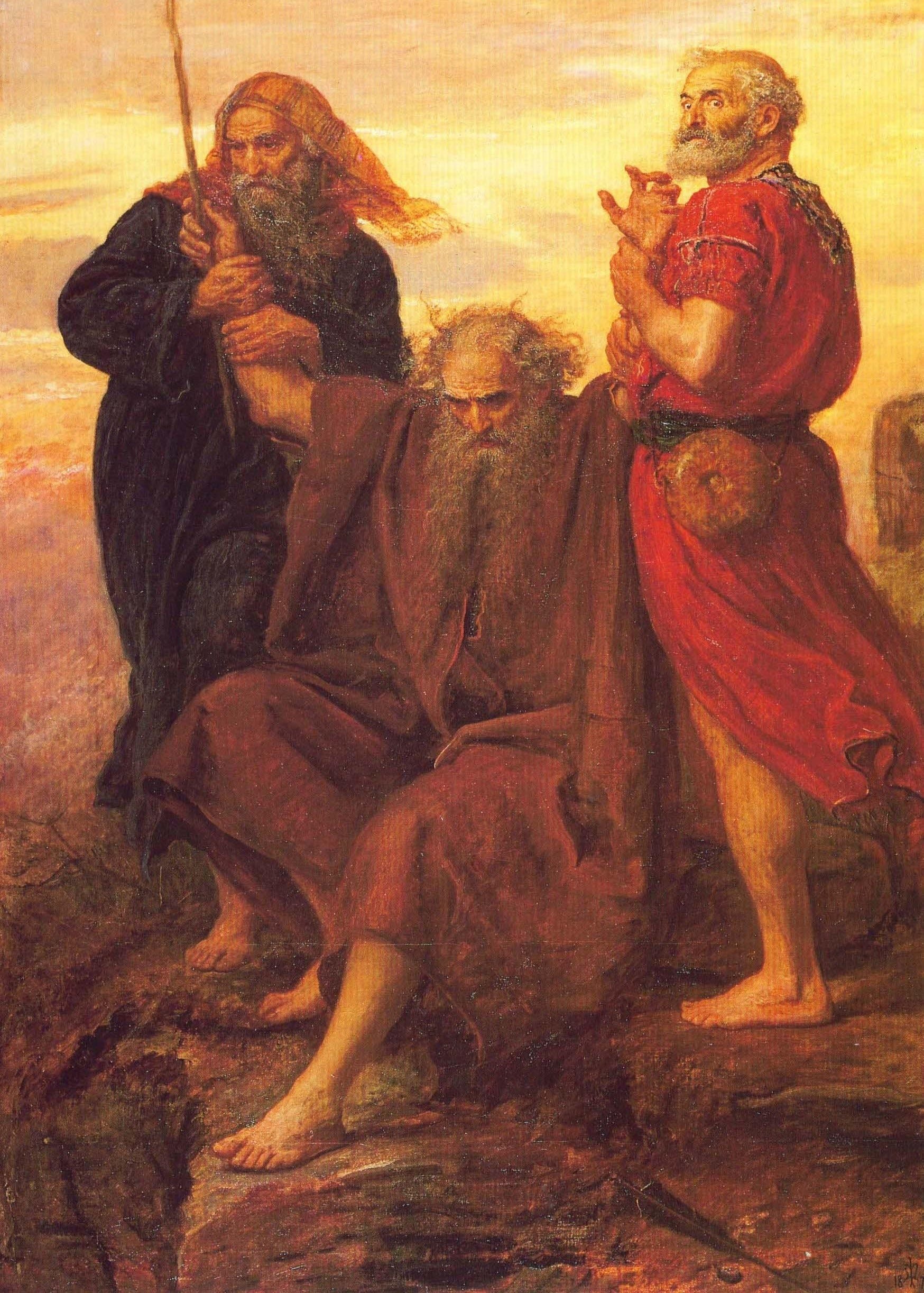
Specifically, Moses knew what he had to do. He saw the benefits of doing it. The stakes were high: When he let his arms fall, Joshua’s men suffered. When he kept them raised, they succeeded.
But Moses couldn’t do it alone.
He needed to sit down, and more importantly, he needed Aaron and Hur to hold up his hands.
How many times do we just try to forge on ahead by ourselves?
How much more successful might we be in our endeavors—be they our endeavors of faith, work, or family life—if we enlisted the help of others?
How much more fruitful might our communities be if we noticed when others need us to hold up their hands amid the battle?
On this point of community and healthy relationships, ancient wisdom and social science converge. If we try alone, we’ll often fail alone. Trying together is what’s required in the long run for survival.
Like many things in life, it’s a bit of a paradox. When we focus solely on ourselves and our individual success, we ultimately become fragile. But when we focus more on others and supportive relationships, we become resilient—and individual success often follows.
Please note: The opinions and views expressed here belong solely to the author and do not necessarily reflect those of the Department of War (DoW) or its components. Any mention of commercial products or services does not imply DoW endorsement. Additionally, the presence of external hyperlinks does not signify DoW approval of the linked websites or their content, products, or services.
Learn more about Crucibles, my forthcoming book:

It took 27 years of my life to accept that we were never meant to do everything on our own. The freedom that comes when you realize the entire world does not depend on you doing everything correctly and without help is incredible. We are needy and dependent creatures, we need God AND others. when we can accept this about ourselves we can live much freer and life giving lives.